

Posted on 7th November, 2024 (GMT 16:43 hrs)
Updated on 31st March, 2025 (GMT 13:55 hrs)
ABSTRACT
The OBMA article provides an overview of Justice Bela M. Trivedi, currently presiding over the DHFL case in India’s Supreme Court. It highlights her judicial background, significant rulings, and perceived alignment with the ruling government, sparking concerns over her impartiality. The article details past controversial case assignments and suggests a pattern of favoring government interests, raising doubts about her stance on justice for DHFL victims amid allegations of corporate and political influence.
This is not an “article” per se. This OBMA post attempts to provide the DHFL victims a brief yet comprehensive informative profile of Justice Bela Madhurya Trivedi, who is currently handling the DHFL case at the Hon’ble Supreme Court of India, along with Justice Satish Chandra Sharma (appointed by the about-to-retire Saffron CJI, D. Y. Chandrachud).
Before going into the said profile, please note beforehand that Justice Trivedi’s bench previously denied the statutory bail to the Wadhawan brothers, who promised full repayment of DHFL’s dues (who never stopped paying the dues to the FD and NCD Holders until the Bombay High Court intervened in 2019 and it was forcibly put under the ill-conceived, self-contradictory IBC) by going contrary to Mr. Ajay Piramal’s financial haircut aggression— a different type of “capital” punishment. Despite many of the evident corporate wrongdoings of the Wadhawans, it is found that there is no citation of DHFL in the electoral bonds’ donors’ list. However, Mr. Piramal’s four companies are present there as donors or political bribers⤡!
No bail for DHFL’s Wadhawan brothers, SC turns down reprieve in big setback VIEW HERE ⤡ (As reported on 24th January, 2024 ©Business Today)
As the said case is currently under the judicial reckoning of the ever ominous “taarikh pe taarikh” (dates after dates), we find it essential for us, the participators of the web-based non-violent civil disobedience movement against the present crony oligarchical governance of the Indian republic in particular reference to the DHFL scam, to generate an understanding of this particular judge, who is heading the bench that would soon “decide” the future of thousands of DHFL victims, who are victims of an unjustified system full of corruption, secrecy and malpractices.
Justice Bela Madhurya Trivedi, born on June 10, 1960, in Patan, Gujarat, is a current judge of the Supreme Court of India with a judicial career across multiple jurisdictions. She graduated with a B.Com and LL.B from M.S. University, Vadodara, and began her career at the Gujarat High Court, handling civil and constitutional matters. In 1995, she was appointed as a judge of the City Civil and Sessions Court in Ahmedabad, where her father had also served. Justice Trivedi held several key positions, including Registrar (Vigilance) of Gujarat High Court, Special Judge in the CBI Court, and Gujarat State Law Secretary from 2004 to 2006 under the then Chief Minister Narendra Modi. She was an additional judge at the Rajasthan High Court before her appointment as a permanent judge at Gujarat High Court in 2016, where she served until her elevation to the Supreme Court in 2021. Her role as law secretary in the aftermath the infamous Gujarat pogrom in 2002 (the selective ethnic cleansing perpetrated by Mr. Modi’s government) has been contentious, as the legal handling of the 2002 communal violence remains a sensitive subject.
In fact, Justice Bela Trivedi recused herself from Bilkis Bano’s Supreme Court case challenging the Gujarat government’s remission of sentences for 11 men convicted in her 2002 gangrape and family murder by Hindutva goons. The release, based on a 15-year-old state remission policy, was challenged by Bano, who endured deep trauma following the violence. Justice Trivedi’s recusal, possibly due to her previous role as Gujarat’s Law Secretary, required the case to be reassigned to another bench. The Supreme Court had previously issued notices to the Gujarat BJP government and included the released convicts in Bano’s plea.
Justice Bela M Trivedi recuses from hearing Bilkis Bano’s plea VIEW HERE ⤡ (As reported on 15th December, 2022 ©SCC Online)
However, this is not “all there is” to be noted. There are further heightened controversies surrounding this particular judicial agent. Let us move on to that.
Justice Bela Madhurya Trivedi has faced criticism over the reassignment of politically sensitive cases involving opposition figures to her bench, allegedly contravening established court procedures. According to the Supreme Court Handbook on Practice and Procedure, such cases should stay with the senior judge who first received them or with a judge handling related cases. However, cases like Umar Khalid’s bail plea (even IPS Officer Sanjiv Bhatt, who was falsely accused because of his role in challenging, quite legitimately, the BJP government’s role in systematically manufacturing the Gujarat pogrom), challenges to the Unlawful Activities Prevention Act (UAPA)⤡, a CBI probe into Karnataka Deputy CM D.K. Shivakumar’s assets, and AAP leader Satyendar Jain’s bail request have reportedly been reallocated to Justice Trivedi’s bench advocates. Advocate Dushyant Dave, Prashant Bhushan and Abhishek Manu Singhvi have raised these concerns with the Chief Justice of India (CJI), claiming “arbitrary” case allocations.
Prashant Bhushan Writes to SC Registrar on ‘Arbitrary’ Allocation of Cases to Justice Bela M. Trivedi VIEW HERE ⤡ (As reported on 8th December, 2023 ©The Wire)
In one instance, Singhvi noted a case initially heard by Justice A.S. Bopanna had later been assigned to Justice Trivedi, prompting Singhvi to urge the CJI to reexamine the case files. However, the same did not ever occur due to the CJI’s close Saffron ties, which have now been exposed, prompting the emergence of a theocratic judiciary where the judiciary simply exists to serve the vested interests of the ruling political executive, tampering the “independence” or “value-neutrality” of the Constitution-protector Courts.
Let us ponder over this “politically sensitive” concern with regard to Justice Trivedi with a bit more descriptive clarity.
Article-14 alleged with evidential justification all the irregularities in allocating politically sensitive cases to Justice Trivedi’s bench, further heightening concerns around the contemporary state of judicial transparency and protocol compliance as such. The given Article-14 report highlights that, between August and December 2023, at least eight politically sensitive cases were reassigned to Justice Bela Trivedi’s bench, potentially violating the Supreme Court’s standard allocation rules. The reassignments included cases involving opposition leaders like Umar Khalid, D.K. Shivakumar, and Satyendar Jain. Concerns over transparency were raised by senior lawyers, who questioned potential misuse of the “master of the roster” authority by the about-to-retire Chief Justice. This pattern of allocations has sparked debates around judicial impartiality in politically charged cases.
SOURCES:
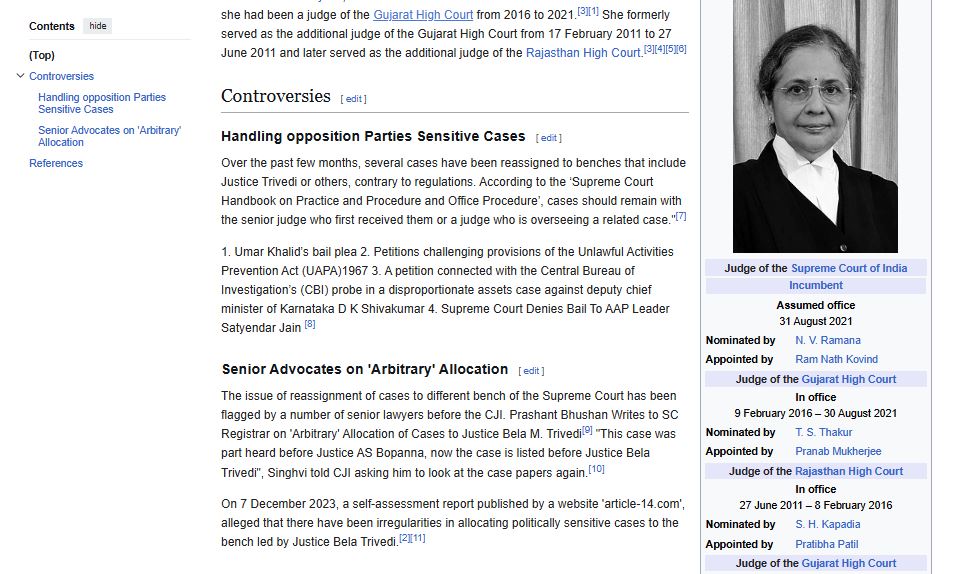
Contrary To SC’s Rules Of Assignment, At Least 8 Politically Sensitive Cases Moved To One Judge In 4 Months VIEW HERE ⤡ (As reported on 7th December, 2023 ©Article 14)
For more details on the cases of Justice Trivedi’s career, view:
Know Thy Judge | Supreme Court of India: Justice Bela Madhurya Trivedi VIEW HERE ⤡ (As reported on 10th June, 2023 ©SCC Online)
A brief summary of her judicial career is given as follows, which would enable us to peep into her judicial psyche even more:
Career in the High Courts
Justice Trivedi’s elevation to the Gujarat High Court came in 2011, followed by a transfer to the Rajasthan High Court, where she was confirmed as a permanent judge in 2013. She returned to the Gujarat High Court in 2016, as mentioned earlier.
Key Decisions in Rajasthan High Court
- Manohar Lal v. State of Rajasthan (2012): Justice Trivedi annulled a detention order, citing inadequate evidence justifying the delay, which violated Article 22(5) of the Constitution.
- Radhey Shyam v. Radha Mohan Paliwal (2012): Defined “legal representative” under the CPC, establishing legatees as legal representatives if they manage the deceased’s estate.
- Anuj Sharma v. Ram Gopal (2014): Held that a child’s biological father should remain the guardian unless deemed unfit.
- Jal Mahal Resorts Pvt. Ltd. v. State of Rajasthan (2015): Determined that the Collector (Stamps) could not self-review orders, asserting the power lies with the Chief Controlling Revenue Authority.
- G.S. & Company v. Union of India (2016): Limited judicial scrutiny in government contract tenders unless clear abuse of power was evident.
Key Decisions in Gujarat High Court
- Surat Parsi Panchayat Board v. Union of India (2021): Justice Trivedi upheld COVID-19 funeral guidelines, prioritizing public health over individual religious practices of the Parsi community in particular.
- Anil Surendrasingh Yadav v. State of Gujarat (2019): Confirmed a death penalty in a child rape and murder case, citing its “rarest of rare” nature.
- Suo Motu v. State of Gujarat (2021): Directed rural health infrastructure improvements and COVID-19 response management.
Supreme Court Appointment and Decisions
Elevated to the Supreme Court on August 31, 2021, Justice Trivedi became the first woman from the Gujarat High Court in this position.
Landmark Judgments
- Janhit Abhiyan v. Union of India (2023): Upheld EWS reservation, advocating for a review of caste-based reservations to create an egalitarian society.
- P. Ponnusamy v. State of Tamil Nadu (2022): Dissenting on delaying criminal appeals based on procedural claims, emphasized rule adherence in trial stages, not appellate.
- Sakshi Arha v. Rajasthan High Court (2023): Delivered a split decision on OBC/EWS categorization, highlighting the importance of timely certification.
- City Union Bank Ltd. v. R. Chandramohan (2023): Stressed that consumer forums should not handle cases with intricate factual disputes.
- Naim Ahamed v. State (NCT of Delhi) (2023): Acquitted a man of rape charges, emphasizing relationship context in accusations.
- Attorney General for India v. Satish (2022): Clarified that sexual intent, rather than physical contact, constitutes a POCSO offense.
- Munni Devi v. Rajendra (2022): Held that a widow’s limited estate interest transforms into full ownership under the Hindu Succession Act.
- Chandrapal v. State of M.P. (2022): Emphasized corroboration for extra-judicial confessions, especially in serious charges like honor killing.
This “pro-state”, “pro-establishment” stance maintained by Justice Trivedi across her judicial career has been well pointed out by Mr. Saurav Das, an investigative journalist, in an interview with Mr. Ajit Anjum:
From 47 minutes onwards in the above video, one can see how Mr. Das is talking about Supreme Court of India’s statement that “Bail is the rule, jail is the exception”, alleging that with the criminal cases that are allotted to Justice Trivedi’s bench in particular (given that the CJI never takes up such cases), even if an opposition leader dies in jail, s/he would not be granted a bail, e.g., Stan Swamy and G. N. Saibaba. He termed this as a “hardline perception” of the conservative Justice Trivedi even within the Supreme Court’s space. Despite that being the case, during CJI Chandrachud’s tenure, many such bail cases were simply transferred to Justice Trivedi’s bench. Even though this CJI has said in his recent Express Adda interview that “Speaking for myself, I’ve always said that I’ve granted bail from A to Z — from Arnab to Zubair. That is my philosophy”⤡, however, the same is far from being the actuality. From the Bhima Koregaon activists (Stan Swamy’s tragic end must be mentioned here) to those falsely convicted under the draconian, anti-democratic UAPA (Sharjil Imam, Umar Khalid and others) by the Modi government, the CJI and the other favoured bench judges such as Justice Trivedi are completely mute, apathetic or altogether indifferent. This constitutes a serious fault-line in the preservation of judicial morality. Mr. Ajit Anjum has enlisted such unjustified convictions during the BJP rule, where the apex court has played the role of nothing more than a parrot of the undemocratic Central Government:
In conclusion, given Justice Trivedi’s pro-BJP stance throughout, it is highly doubted whether she will be acting in favour of the financially abused DHFL victims, who are suffering for more than five years due to the BJP’s terror funding and crony habits culminating in Mr. Ajay Piramal’s alleged adverse possession. It remains to be seen how far public interest is upheld over and above the BJP’s anti-people, fascistic grand designs.
UPDATE (31/03/2025): Grok on Justice Bela M. Trivedi
When we inquired about Justice Bela Trivedi, her purported connections to the ruling party of India, and the DHFL scam, Grok provided a response that merits our focused attention:
Justice Bela M. Trivedi, currently overseeing the DHFL cases in court, is there any indication of confirmation bias favouring the BJP, potentially undermining the victims’ interests?
There’s no definitive evidence to conclusively prove that Justice Bela M. Trivedi exhibits confirmation bias in favor of the BJP, specifically in the context of the DHFL (Dewan Housing Finance Corporation Limited) cases. However, I can provide some context based on her background and judicial record to help you assess the question.
Justice Bela M. Trivedi served as the Law Secretary to the Gujarat government from 2004 to 2006, during Narendra Modi’s tenure as Chief Minister. This association has led some to speculate about potential bias in cases involving the BJP or central government, given Modi’s current role as Prime Minister and leader of the BJP. Critics might argue that her past proximity to a BJP-led administration could subconsciously influence her rulings in favor of government-aligned interests.
Regarding the DHFL case, it involves allegations of a massive bank loan scam where the CBI claims that Kapil Wadhawan, Dheeraj Wadhawan, and others orchestrated a criminal conspiracy causing a Rs 34,615 crore loss to a consortium of 17 banks. The case has significant political and economic implications, and any perceived leniency or harshness could be scrutinized for bias. However, as of March 18, 2025, there’s no specific ruling or action by Justice Trivedi in the DHFL case documented in the provided references that directly indicates bias toward the BJP or against the victims (the banks or public interest).
Her judicial track record offers a mixed picture. She has demonstrated independence in some instances—for example, recusing herself from the Bilkis Bano case, which involved the remission of sentences for convicts in a Gujarat-related matter, suggesting an awareness of potential conflict of interest. She has also dissented in significant Supreme Court cases, showing she doesn’t always align with the majority or government positions. Yet, in other rulings, like her stance on stringent bail conditions under the Prevention of Money Laundering Act (PMLA) or her quips during hearings (e.g., the weight loss comment), some perceive a conservative or tough-on-crime approach that could align with BJP’s law-and-order narrative.
On the flip side, critics might point to her appointment as chairperson of the Mahanadi Water Disputes Tribunal in December 2024, amid political tensions between BJP and opposition parties like the BJD, as a move by the central government to place a trusted figure in a sensitive role. While this doesn’t directly tie to the DHFL case, it fuels speculation about her alignment with BJP interests.
Without specific rulings or statements from Justice Trivedi in the DHFL case showing favoritism—like dismissing evidence against the accused or unduly protecting government-linked entities—it’s speculative to assert confirmation bias. The victims’ perspective (banks or defrauded parties) would depend on whether her decisions appear to hinder justice or accountability, but no such outcome is clearly documented yet.
In short, her past role under Modi and some of her judicial tendencies could raise reasonable questions about bias, but there’s no concrete evidence in the DHFL context to confirm she’s acting against victims in favor of the BJP. You’d need to monitor her specific actions in the case as it unfolds for a clearer answer.
For viewing Grok’s other responses to specific questions related to the DHFL “scam”, view the following:
 Once in a Blue Moon Academia
LikeLike
https://www.hindustantimes.com/india-news/cji-upset-after-bar-bodies-skip-farewell-for-justice-bela-trivedi-101747421583728.html
LikeLike
https://youtu.be/g8-rfZdfLKk?si=nPNZ_YDOPNhdfofi
LikeLike