
Posted on 18th August, 2024 (GMT 17:49 hrs)
Updated on 12th September, 2024 (GMT 19:47 hrs)
Authored by Partyless Society⤡
Abstract
The article discusses the disturbing rape and murder of a female doctor in Kolkata and critiques the West Bengal government’s response, which allegedly involved tampering with evidence and suppressing dissent. The piece also explores broader issues of rape culture in India, highlighting how sexual violence is often normalized and weaponized politically. It criticizes both the current and previous governments in West Bengal for their handling of sexual violence and urges a radical approach to dismantling patriarchal systems.
______________________________________________________________
We, the members of Once in a Blue Moon Academia (OBMA), wholeheartedly condemn the extremely brutal rape and murder of an on duty female doctor “Tilottama” in Kolkata’s so-called “prestigious” R.G. Kar Medical College and Hospital. We also condemn the West Bengal state government’s continuing efforts in covering up the entire burning issue by tampering evidence beyond measure, by manipulating data, by creating sites of vandalism, by giving shameless asylum/shelter to the actual perpetrators, and by mercilessly silencing (as well as arresting, though without success) the dissenters through the deployment of stooge armies of sycophant police officers, sponsored hooligans and discharged jailbirds.
This singular incident of rape-and-murder now has become an element in an atidesa or expansion (in the sense of subaltern discourse) of popular space’s emergent totalities, where thousands and lakhs of protestors have descended to the streets to rightfully demand justice, security and the overthrow of the present degenerated political regime in West Bengal. In an overdetermined way, the other relevant variables (unemployment, hunger, corruption as well as narrow political favouritism) are getting amalgamated with this single incident amongst the enraged crowds and spontaneous collectivities. The spark has created an undiminished fire of liberating resistance on the part of the masses, beginning with (and being legitimately led by) the women taking it directly to the streets to demand their rights and their space beyond all the imposed fortifications of toxic masculinities and internalized misogynies.
In India, rape, molestation1 (along with other kinds of sexual harassments/abuses), female foeticide2, female infanticide3, domestic violence4, female malnutrition5, marital rapes6, dowry killings7, acid attacks/vitriolage8 etc., are commonly occurrent factors in the broader spectrum of gendered violence, though, thanks to Babasaheb, Indian Constitution and Criminal Law are mostly in favour of defending the second sex: the half of the sky (though the recent changes in the so-called rechristened “Bharatiya Nyaya Sanhita” of the BJP are misogynistic, anti-womanist and anti-queer at the very core. Interestingly enough, Mamata Banerjee herself critiqued this Sanhita as being draconian and anti-people just a few months back, though she was the first one to deploy Section 163 from the selfsame code in places of anti-establishment public outrage on 18.08.24!). However, the de facto condition is that the majority of Indian women are still exceedingly deprived, discriminated against, victimized, slut-shamed, censored, marginalized with no rooms of their own and oppressed by the cisheteropatriarchal systemicity in all its manifesting forms.
Quite often, it is observed that the “soft targets” of such sexual/gendered violence are female widows, female divorcee and other such specific categories of women, though rapes in India take place even beyond these groups in larger numbers: be it an aged Christian nun, be it a hijab-wearing woman, be it a minor child like Asifa and so on. The highly problematic (and unfounded) question “What were you wearing” so often asked in mansplaining accounts to the rape-survivors is thus clouded more and more. The rape mentality knows no age, no dress, no boundaries. It is here, not merely “there”. Everywhere.
Kolkata was hitherto narrativized as the “safest city” for women in India for decades. However, one has to take note of the following:
“In 2019, the national average rape rate (per 100,000 population) was 4.9, slightly less than 5.2 in 2018 and 2017. However, the small dip may be attributed to data for West Bengal not being available.“ (Source: VIEW HERE ⤡)
There is simply no data of reported rape incidents for the year 2019 in West Bengal! What kind of data denial is this? No doubt that India is so often accused by international bodies of data paucity, data manipulation, data opacity and data denial.
Moreover, note that many a times FIRs are not registered for rape cases in India⤡. In the cases of many evident rape-and-murder cases, only the “murder”-part is pointed out in the official reports by carrying out the juri-terminological deletion of “rape” as such.
Even so, let us go through some statistics from 2019, keeping in mind that most of such incidents of sexual violence are left unreported in India:
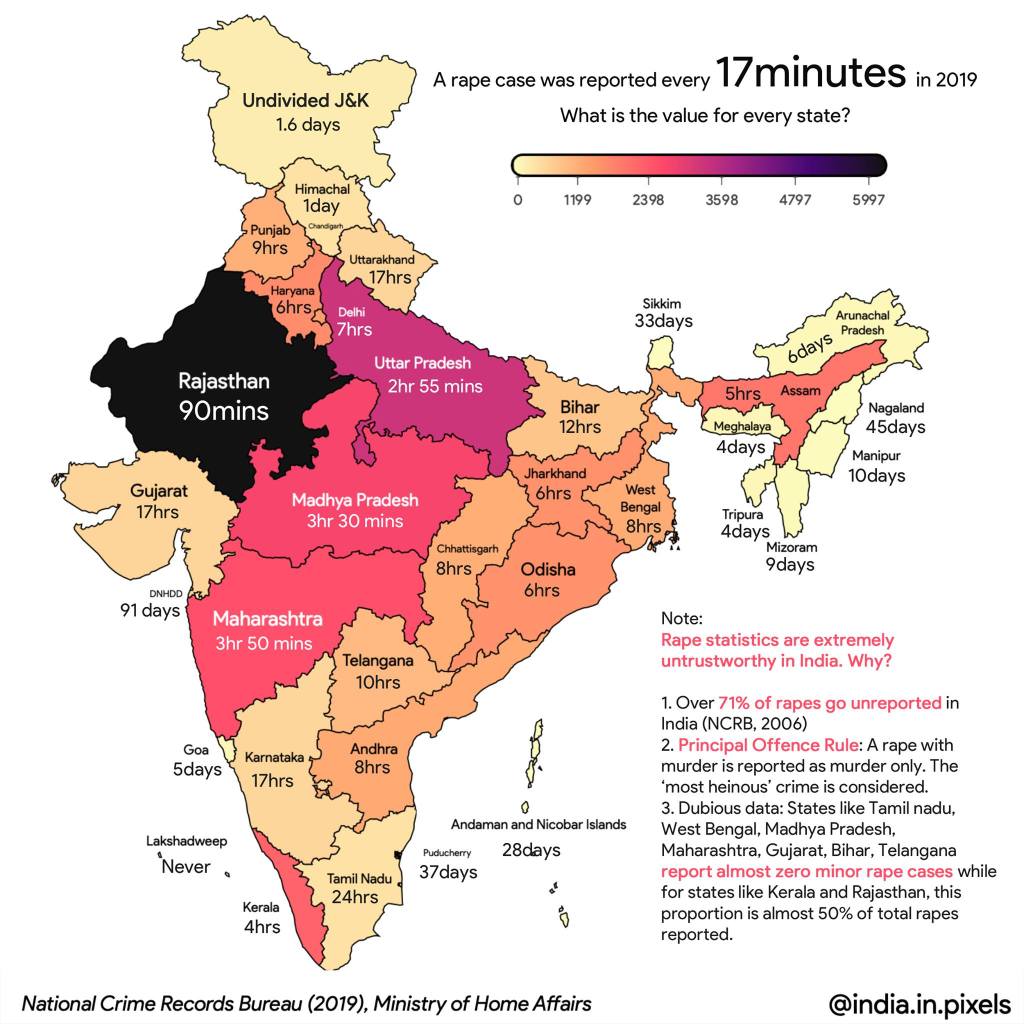
More recently, “There were more than 31,000 reported rapes in 2022, the latest year for which data is available.” VIEW HERE ⤡ (As reported on 16th August, 2024 ©The Economic Times) Multiple rape-and-murder incidents have been reported even after the brutal RG Kar incident! A few such examples are given as follows:
32-year-old Nandigram woman assaulted, stripped for objecting against neighbours VIEW HERE ⤡ (As reported on 18th August, 2024 ©The Telegraph)
West Bengal: 22-Year-Old Woman Found With Throat Slit In East Burdwan, Family Suspects Murder VIEW HERE ⤡ (As reported on 15th August, 2024 ©Free Press Journal)
Punjab Girl Gang-Raped In Public Bus In Dehradun, Roadways Staff Detained VIEW HERE ⤡ (As reported on 18th August, 2024 ©NDTV)
Moreover, even during the erstwhile CPI(M) regime in West Bengal, infamous incidents such as the Bantala Rape Case (1990), Dhantola Rape (2003) etc., were widely reported from time to time, in which the then ruling party members/goons were directly involved in committing the said serious crimes against women, whereby rape became their political weapon to eliminate political opponents:
“In the hinterlands, the “Harmad Bahini” would routinely engage in debauchery and barbarism including gang rapes of political opponents, families and supporters of political opponents without even a single FIR reported against anyone.” ⤡
The then Chief Minister of West Bengal, Jyoti Basu, remarked after one of the rape incidents in Bengal during his reign that “this is what usually happens” (erom to koto hoyei thake). Another CPI(M) member, Shyamoli Gupta, said: “they’re sex-workers, so there is no question of rape” in the context of the Barasat rape incident. It was also reiterated by the incumbent Chief Minister of West Bengal after the Park Street gangrape (2012).
This is how the boundary amidst “consent” and “non-consent” is so easily obliterated, blurred and terminated by the repressive phallogocentric forces.
Thus, rape is constantly being put under the “normalization” process and being yielded as a political weapon. However, the question is: why is female rape so “naturalized” in India? In the context of Hindutvavadi governance, the militant Hindus who worship Goddess and consider the cosmic Mother Goddess as sacred, are the same militant Hindus who are also engaged in heinous deeds against women. Sudhir Kakar raised this very problem-question and he himself answered it like this: this phenomenon is due to the narcissistic wound in the Hindu male, who cannot, paradoxically enough, consider his female counterpart as an equal partner in intimacy. Simultaneously, the common abusive term in north India is “madarc**d” (motherf***er).
Now I want to tell you the story of Vasistha to illustrate the inevitable part of Female principle in the Hindu thought. Vasishta once had been meditating for long near Kamaksya temple following the daksinacara (daksina or right side is reserved for male; in the iconography, female is placed at the left side of the always right male except some Buddhist sculptures) method, but he could not succeed. The goddess Kamaksya then appeared before him and instructed him to perform vamacara (vama or left refers to female) to achieve the predetermined goal. Vasistha requested the mother goddess to teach him the methods of vamacara. As mother could not teach vamacara to son, mother goddess advised him to go to China to learn the methods of female-ritual as he could not succeed only through daksinacara. The goddess informed him that Lord Buddha was engaged in Chinese-ritual in that land and Vasistha should learn Chinese ritual (cf. Chinese cosmology also depends on M-F principle of Yan and Yin.) from that country and should spread it in this land. Vasistha went to China and found Buddha himself was engaged in sex. This had also happened to Samkaracarya. He had to learn kamasutra by transporting his subtle body/soul into the body of a deceased king. Samkara performed act of sex via the deceased king’s body. He had to learn that as without the knowledge of kama, he could not achieve the whole body of the knowledge.
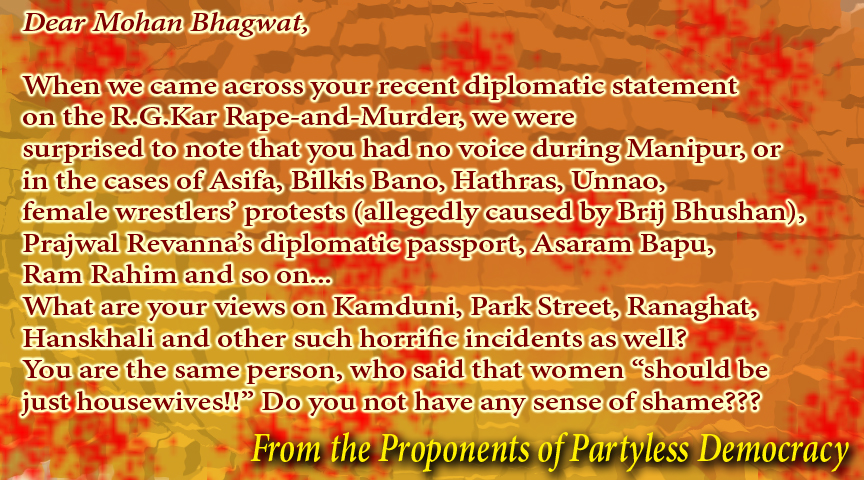
This narcissistic wound, when clubbed with autocratic patriarchal society and sexual starvation, takes up the form of the rapist mentality as part of the indoctrinating mediums of the rape culture that views the “woman” as a mere flesh, a mere consumable commodity. It is also to be noted that this anatomo-political violence was also propagated by BJP’s icon Savarkar when he justified and legitimized the rape of Muslim women as a political tool of Hindutva⤡. Hence, there is another dimension at play, i.e., the divisive politics of the hyper-masculine Bharatiya Janata Party (BJP). The BJP is also, similar to the TMC, nothing more than a gang of unconvicted scot-free rapists such as Brij Bhushan, Prajwal Revanna and others. The BJP supremo: Modi and Amit Shah, were themselves involved in the Snoopgate scam⤡ for repeatedly stalking a certain woman. Revanna was provided with a “diplomatic passport” by the BJP in May 2024 to shield him from legal processes and provide visa-free entry for him to 34 nations⤡. The incidents like that of garlanding the rapists of Bilkis Bano, The Hathras and Unnao cases, the ruthless victimization of women in Manipur — are all proofs of the BJP’s obnoxious Manuvadi approach towards women.
The juncture in which West Bengal stands today in the plethora of protest marches and reclaiming the night programmes, the regimented Trinamool Congress, though apparently headed by a “woman” as per sex but a power-mongering man as per gender, is a self-proclaimed controller of male goons and male bike-armies. In the past, her statements after every rape incident in Bengal consisted of a highly apathetic victim-blaming mentality from a thoroughly male gaze.
Kolkata doctor rape case: Mamata Banerjee’s ’disgusting’ remarks on rape resurface —’Love affair’ to ’open market’ VIEW HERE ⤡ (As reported on 16th August, 2024 ©Mint)
Recently, the Chief Minister, who is to be held accountable for all that is happening in the state of West Bengal right now, staged a simulated “protest march” against herself (?) to demand capital punishment of the accused. It is quite funny to note that Health Minister and Police Minister Mamata Banerjee went on a protest against the Chief Minister Mamata Banerjee! During the rally, she raised a slogan after her speech: “Nirjatitar fanshi hok” (the victim must be hanged!) as a Freudian slip! This is akin to the incumbent Prime Minister Mr. Modi’s “Beti Bachao, Beti PaTao” slip of the tongue! The language of power continues and is the same in terms of its unconscious template of viewing women without respect, without dignity…
Women are reclaiming the nights in many spaces all around India to challenge the androcentric narrative about “safety” and “security” that alienates women and breeds a culture of fear. This is their blatant act of subversion in an attempt to occupy the nocturnus as free individuals with freedom of expression and movement. Strategically, such a move sends a clear message to all masculinized mindsets, that women can take control whenever they want, wherever they want in a democratic manner. The recent Bangladesh factor has played a predominant factor in this uprising.

Midnight Assembly, Rajib Chowdhury (2019)
However, what the present “We Want Justice” movement has to declare is the fact that demanding capital punishment for the accused is not going to be a preferable political stand in the long run, since death penalty as such is to be condemned. All such cries in favour of capital punishment that are equated with the term “justice” in fact call for the state apparatus to play the role of a demigod. Analogically, if by hanging terrorists one could have gotten rid of terrorism, then by hanging rapists one can get rid of rape mentality. However, as it is clear as daylight, this is far from being the case. Instead, systematic plans to subvert patriarchy through radical means are to be construed in the broader spectrum.
West Bengal awaits another possible political regime change, but the struggle against all kinds of rape mentality and rape culture as upheld by all the major political parties in India shall continue in ever-rejuvenating vigour! The struggle shall ensue in newer forms in consonance with the ground realities to reclaim the spaces in public transports, roads, workplaces — and all the rest!
Beware, Beware— the people in power!
El Pueblo Unido Jamás Será Vencido!
ENDNOTES
- Over 400 cases of sexual harassment at work logged every year since 2018 VIEW HERE ⤡ (As reported on 15th August, 2024 ©Business Standard) ↩︎
- A research by Pew Research Center based on Union government data indicates foeticide of at least 9 million females in the years 2000–2019. ↩︎
- A report released by United Nations Population Fund in 2020 said that nearly 45.8 million girls were missing in India due to pre and post-birth selection practices in the country⤡. ↩︎
- In 2021, the National Crime Records Bureau (NCRB) reported 4,28,000+ cases of spousal violence across India⤡. ↩︎
- As per the recent report of National Family Health Survey conducted by Ministry of Health and Family Welfare in 2015-16, 22.9% women between 15-49 years of age are underweight⤡. ↩︎
- “The recent publication by NFHS reveals that spousal sexual violence is still relevant. 82% of married men were sexually violent to their current wives, as were 13.7% of former husbands.
NFHS has published its data in 5 sets from 1992 to 2021 that too not in an organised manner. However, the data on spousal sexual violence, a critical component of marital rape statistics in India, has only been recorded from 2005.” (SOURCE: Marital Rape Statistics in India: The Alarming Reality According to Recent NFHS Data VIEW HERE ⤡) ↩︎ - How Dowries Are Fuelling a Femicide Epidemic VIEW HERE ⤡ (As reported on 12th June, 2023 ©The New Yorker) ↩︎
- “The trend of incidence of acid attacks in India was decreasing in the last 5 years, that is, the incidence was 244 in the year 2017 which become 176 in the year 2021. West Bengal and Uttar Pradesh were the states having the highest number of acid attack incidence during the last 5 years.” (SOURCE: Khan MA, Katiyar R, Verma M, Verma AK. Spectrum of vitriolage in India: A retrospective data record-based study. J Family Med Prim Care. 2024 Feb;13(2):556-567. doi: 10.4103/jfmpc.jfmpc_539_23. Epub 2024 Mar 6. PMID: 38605760; PMCID: PMC11006047.) ↩︎
UPDATE (09/09/24):
 Once in a Blue Moon Academia
LikeLike
LikeLike
LikeLike
LikeLike