Posted on 21/03/2024 (GMT 17:30 hrs)
Updated on 16/09/2025 (GMT 10:05 hrs)
Authored By Partyless Society ⤡
Abstract
The article investigates why the Wadhawan Brothers—formerly owners of Dewan Housing Finance Limited (DHFL)—have been conspicuously absent from the list of Electoral Bond donors, in spite of previous allegations that they had donated to the BJP through shell companies. The author argues that:
- Missing from the Electoral Bond Lists: Despite earlier claims, the names “Wadhawan” and “DHFL” do not appear in the published donor records of the Electoral Bonds scheme. Once in a Blue Moon Academia
- Past Allegations of Donations via Shell Companies: There is reference to Cobrapost and Congress-reports suggesting that the Wadhawans donated about ₹27.5 crore to the BJP using shell companies. Once in a Blue Moon Academia
- Quid Pro Quo & Crony Capitalism: The article sees a broader pattern of business entities and the ruling party (BJP) engaging in a reciprocal relationship, where financial favours, political contributions, and regulatory indulgence interplay. The opacity of mechanisms like shell companies, trusts, and electoral bonds facilitate this. Once in a Blue Moon Academia
- Bankruptcy Process as Pressure Tool: The DHFL’s bankruptcy is construed not merely as a legal-financial event but as political leverage. The author proposes that pressuring DHFL through insolvency laws (namely the Insolvency and Bankruptcy Code, 2016) served as a demonstration — both to force compliance from the Wadhawans and to set an example for others. Once in a Blue Moon Academia
- Policy & Ideological Critique: Beyond the specifics, the piece makes broader claims about political vendettas, legal selective enforcement, and how financial tools (like donations, shell companies, electoral bonds) are deployed in partisan power games. The author advocates for a “partyless democracy” — decentralised, less money-driven, more horizontal in governance.
In continuation with our previous article
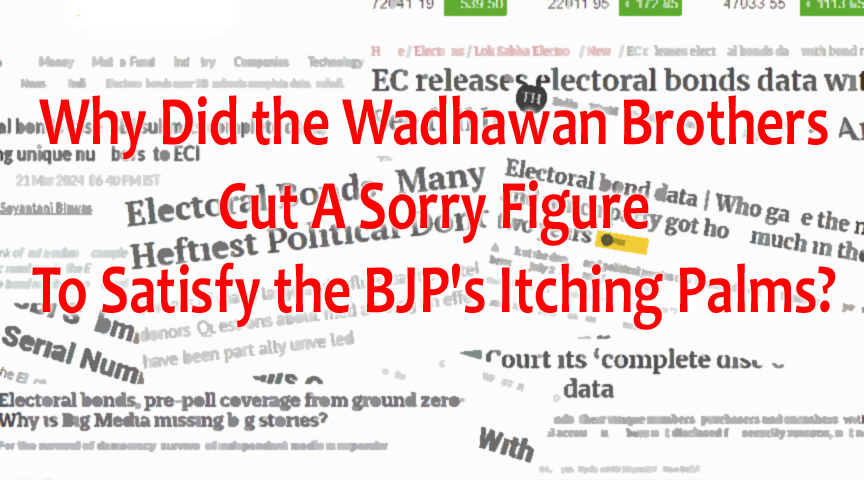
, we wish to ask a few questions after the much controversial exposure of the Electoral Bonds Scam. There is no mention of the Wadhawan Brothers, the ex-(?)owners of the DHFL, in the data published by the SBI (and publicly exposed by the ECI):
We are proud enough that before the publication of such lists, we had inferred that there is an one-to-one correspondence between the rising assets of the ruling party of India and the rampant bankruptcies of the PSUs:
Even the legal phrase “Quid Pro Quo” was used by us to denote the relationship between the Flashnet Scam and DHFL Scam, i.e., Piramal and the BJP’s affinities. We have indeed found Piramal’s name in the list of Electoral Bond Donors to have donated 85 crores!!
After the expose of the Electoral Bonds Scam, we are not at all surprised by seeing such a correspondence between the corporate and the political parties of India in the context of crony and monopoly capitalism⤡.
However, we are surprised enough that the name of “DHFL” or the “Wadhawans” does not even appear in the list of purchasers or donors, as said before.
It is found that before the Operation Lotus, a patterned event has been noticed. The extortionists like ED, CBI and/or IT Department are specifically targeting the opponent members, leaders as well as sitting chief ministers for performing alleged “financial scams”. After that, the targeted opposition leader/party usually joins the ruling party, which then serves as some kind of a “washing machine”. This is nothing more than a political vendetta with the ill-intent of blackmailing the dissenting parties.
To say simply, the Electoral Bonds issue in this context of the BJP-opposition tussle is nothing more than a case of satisfying the itching palms of the ruling party of India by the business tycoons. Many have inferred (rightly) that it is another form of bribery.
However, the question is: why did the Wadhawan brothers as well as Rana Kapoor (YES Bank) cut a sorry figure to satisfy the greedy hands of the BJP? Why were they singled out of all other corporate giants with their shell companies?
The opacity and secrecy of the bonds have made us perplexed, vexed and annoyed. Let us dig our own minds by reflecting on the following points at issue, points at hand:
I. The Wadhawan brothers had already satisfied the ruling party by donating to the latter by opening shell companies a sum of 27.5 crore rupees, as reported in the Cobrapost report in 2019 as well as subsequent press releases by the Indian National Congress.
II. Moreover, there are many means to “donate” (or bribe?) the political parties in India, which include: electoral bonds, electoral trusts, PM CARES Fund (transparently opaque trust?!), terror-funding, hawala etc., in the context of the license raj within post-truth society. The simple thing is that in between the corporates and the ruling party (being the richest and highest earner in Electoral Bonds), there is a certain ‘give-and-take’ or ‘quid-pro-quo’, i.e., “returning of favours” relationship.
III. Each and every corporate has or possesses shell companies for “bribing” aka “donating” to the ruling party of India.
One obvious reason for initiating a bankruptcy process against the Wadhawans’ DHFL in particular was perhaps that the BJP was not satisfied with the comparatively slim amount of 27.5 crore rupees that it received from the Wadhawans.
Moreover, the DHFL, along with its shell companies/fraudulent accounts, “donated”, it maybe assumed, through other means such as terror-funding via the proper channel of Dawood Ibrahim and Iqbal Mirchi. For this reason, electoral bonds’ donors list does not mention them anywhere.
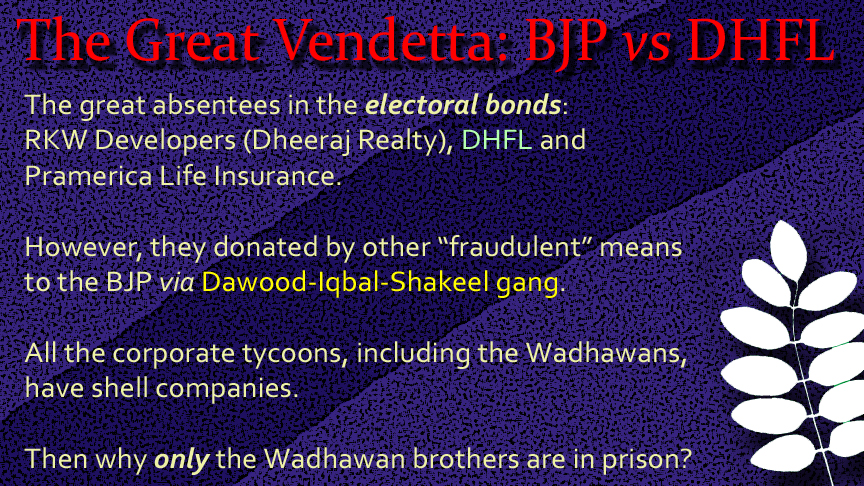
- ‘False’ (?!) allegations on the collusion among the BJP, Dawood-Mirchi and the DHFL: A Letter to the BJP President VIEW HERE ⤡
- AN RTI ON THE ALLEGED COLLUSION AMONG DAWOOD-MIRCHI-RKW-DHFL-BJP VIEW HERE ⤡
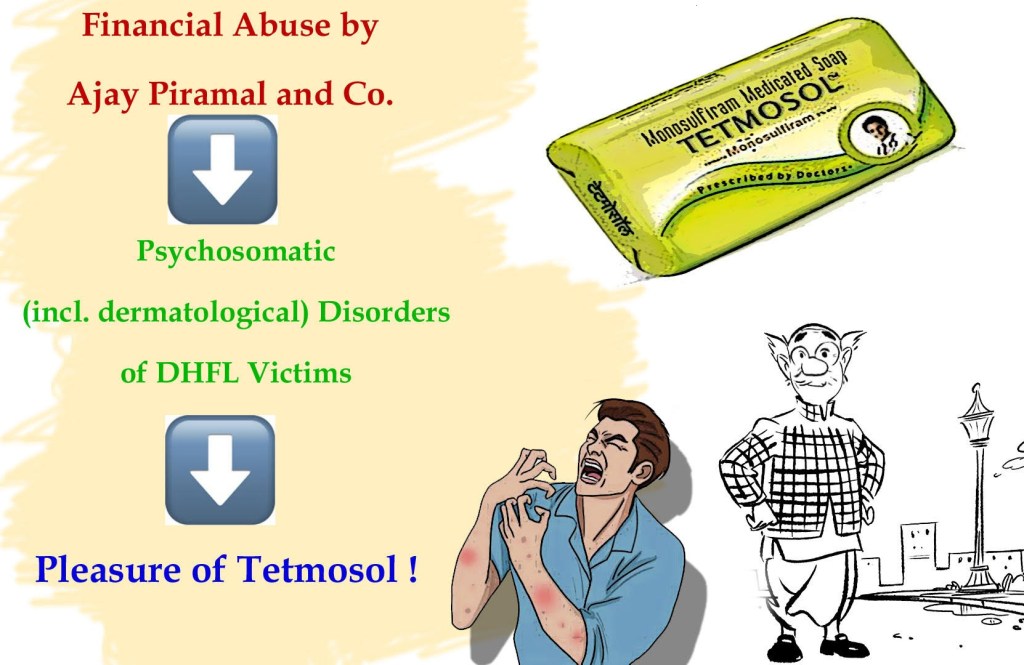
Putting the ongoing DHFL into a bankruptcy process was a “litmus test” case for legitimizing the very ill-conceived code for Bankruptcy, i.e., the IBC (2016), and thus, the DHFL victims were treated as guinea pigs.
Conclusion
We, after going through the utterly depreciated state of affairs in the Indian as well as global polity, where the crony relationship is serving as the life-blood for ALL parties, hereby stand for a partyless democracy.
Such a partyless society would be free from any arbitrary monetary determination via a centralized autocracy or totalitarian power. Instead, it would promote moneyless, decentralized survival in the context of anthropogenic glocal heating or Anthropocene/Capitalocene in general. The ideal of non-partisan social order would promote horizontal mutual aid instead of hierarchical segregation.
 Once in a Blue Moon Academia
https://www.thehindu.com/data/electoral-bond-full-data-complete-list-of-donors-parties-and-unique-numbers/article67976056.ece
LikeLiked by 3 people
https://www.thehindu.com/data/electoral-bond-full-data-santiago-martin-future-542-crore-trinamool/article67977090.ece/amp/
LikeLike
LikeLike