Reading ‘Vande Mātaram’ Across Registers: Text, Myth, Ritual
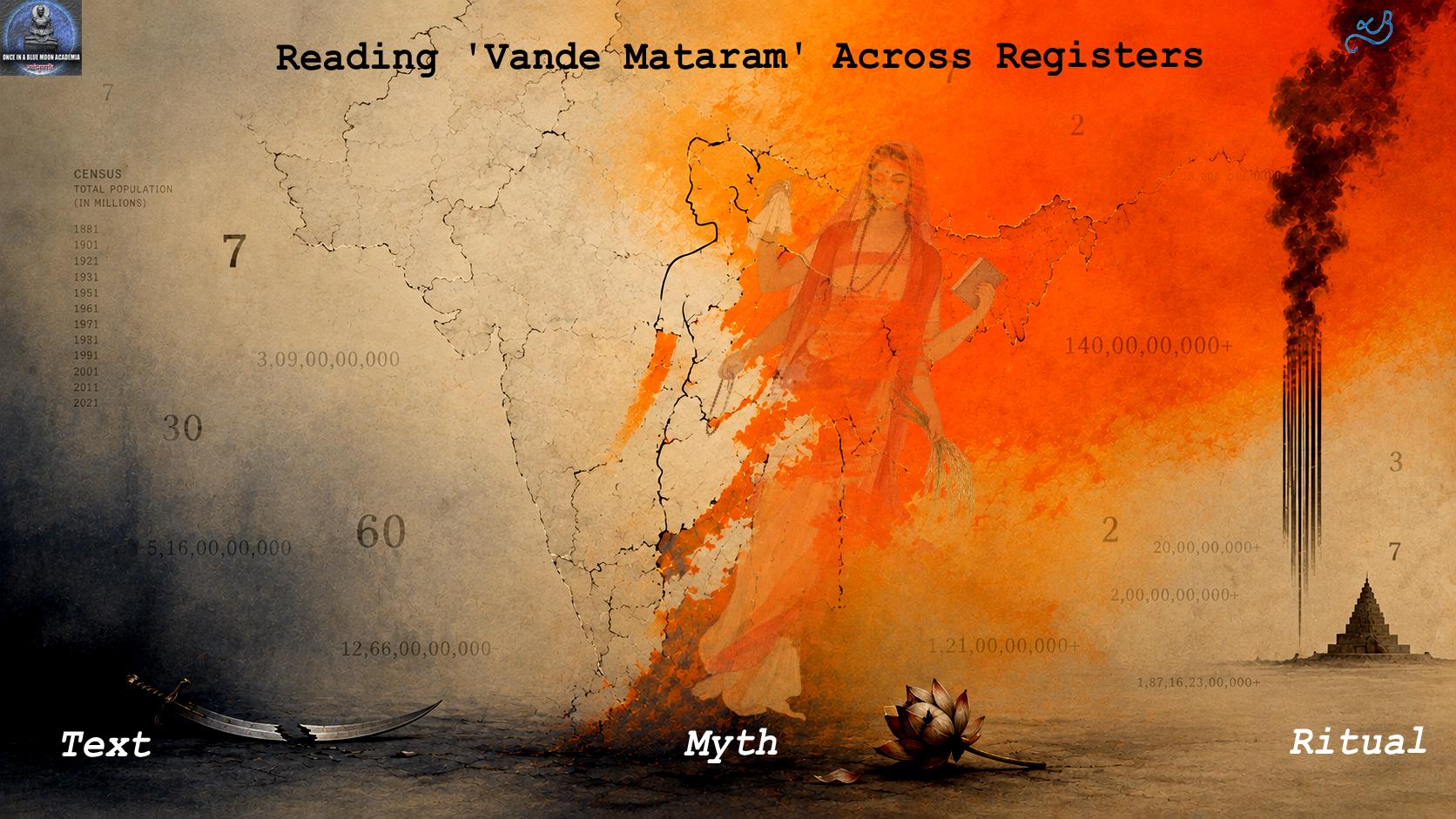
This “reading” traces Vande Mātaram’s discursive transformation(s) from a specifically Bengali hymn into an unstable national emblem and, finally, a ritualised test of belonging. It begins with the demographic hinge of saptakoṭi/dvisaptakoṭi—seven crore throats and fourteen crore arms—corresponding to the Bengal Presidency, not India, and follows its mutation from Bankim’s fixed text to the 1905 inflation of thirty crore, the Republic’s excision of the number-bearing and goddess-identifying stanzas in 1937–50, and the later dissolution into unbounded koṭi-koṭi. Across page, stage, state and popular transmission, the essay asks what happens when a countable provincial people becomes an infinite, unauditable mass. It reads the hymn through the genesis of Ānandamaṭha, Tagore’s counter-discourse of neśā, the colonial genealogy of mātṛbhūmi/mātṛbhāṣā, and the “(M)Other-Tongue” mechanism that manufactures Others. The stanza-by-stanza appendix tests the hymn’s claims of water, fertility, beauty, knowledge, feminine strength and sustaining earth against ecological depletion, educational precarity, demographic violence and extractive concentration, exposing a structure in which the signifier survives while the referent is hollowed out. The blurred number, singular vande, and 2026 penalisation of disruption converge as political ritual: citizen becomes chorus, dissent filial betrayal. The argument is not that singing is illegitimate, but that compelled, unexamined singing surrenders the critical freedom citizenship requires; to decline the chant is not to refuse the country, but to refuse a mistranslation, a miscount, a manufactured Mother, and the disappearance of the historically located citizen into an infinite chorus.
