Speed, Violence and Exclusion: the Legitimation Crisis of India’s Electoral System
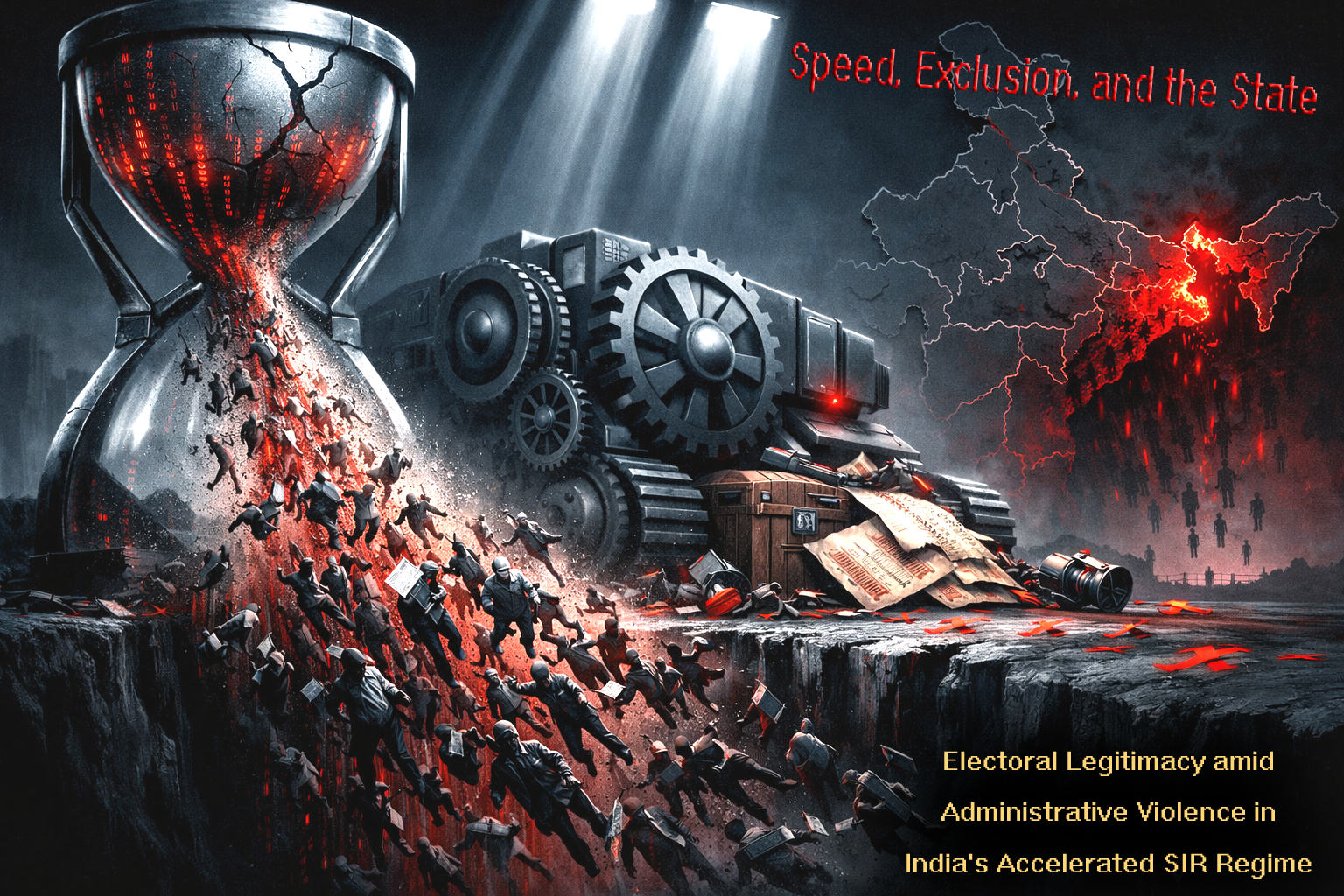
This article critically examines the 2025–26 Special Intensive Revision (SIR) of electoral rolls conducted by the Election Commission of India, arguing that it marks a decisive shift from deliberative enumeration to accelerated exclusion. In contrast to the time-intensive, de novo 2002–03 revision, the current exercise compresses verification into a high-velocity, deadline-driven regime that relies on legacy databases while shifting the burden of proof onto citizens. Drawing on emerging empirical patterns—including mass deletions (over 90 lakh in West Bengal, more than 2 crore in Uttar Pradesh, and over 65 lakh in Bihar), documented worker deaths and distress, and disproportionate impacts on migrants, minorities, and economically vulnerable populations—the article contends that the SIR functions less as administrative “cleanup” than as a system of structured electoral filtration. It further interrogates the role of the Supreme Court of India, whose limited, non-disruptive interventions have allowed the process to proceed within its compressed temporal architecture, thereby reinforcing rather than restraining its effects. Situating the SIR within broader dynamics of accelerationist governance and “speed capitalism,” the analysis demonstrates how administrative velocity, when detached from deliberation, accountability, and human-scale verification, risks transforming electoral governance into an apparatus of systemic disenfranchisement—eroding the epistemic integrity, ethical grounding, and participatory foundations of Indian democracy.
