“Who’s Got the Paper? I’ve Got the Match”: Osibisa and the Politics of Documentation
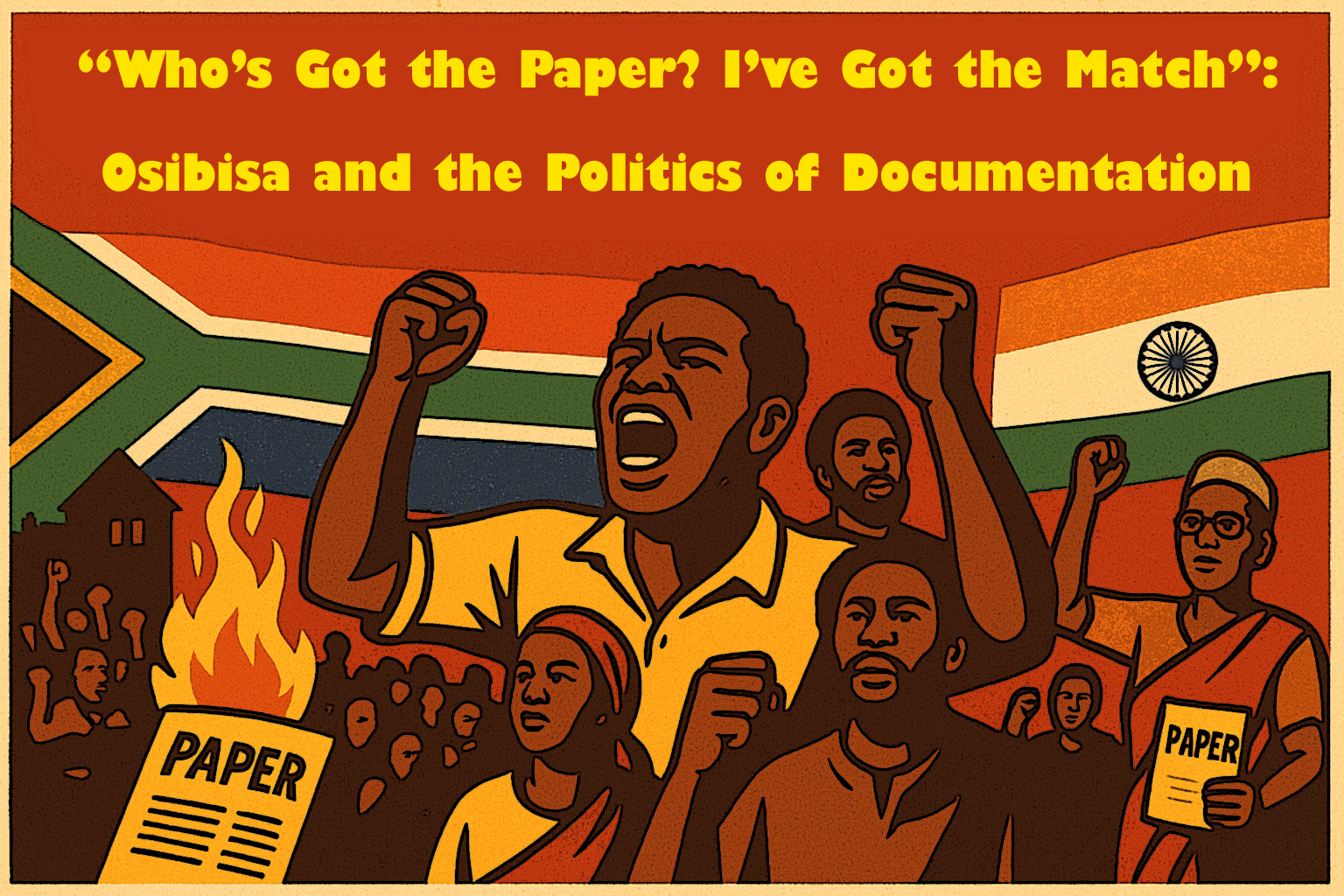
This paper offers an interpretive and historical reading of Osibisa’s 1970s Afro-rock track Who’s Got the Paper? as a sonic meditation on the politics of documentation, identity, and resistance. Beneath its surface as a jubilant “party anthem,” the song encodes a global genealogy of documentary surveillance—from colonial pass laws and apartheid bureaucracies to postcolonial citizenship registers and digital data regimes. The refrain’s dialectical call and response—“Who’s got the paper?” / “I’ve got the match”—stage an encounter between state surveillance and insurgent agency, between the archive’s demand for verification and the people’s capacity for ignition. Combining lyrical analysis with postcolonial, Foucauldian, and musicological frameworks, the paper interprets sound as a mode of political imagination that exceeds textual control. Extending this argument to the Indian context, it situates the song’s critique within contemporary regimes of legibility exemplified by the Citizenship Amendment Act (CAA), National Register of Citizens (NRC), National Population Register (NPR), the Special Intensive Revision (SIR) of electoral rolls, and the Digital Personal Data Protection Act (DPDPA)—each reiterating the colonial “paper logic” of inclusion through exclusion. Drawing upon Michel Foucault’s concept of governmentality, James C. Scott’s notion of legibility, Giorgio Agamben’s “state of exception,” and Achille Mbembe’s necropolitics, the essay argues that Who’s Got the Paper? performs the political imagination of music as resistance—where rhythm becomes revolt and dance becomes dissent. Through the contrapuntal readings of Edward Said, Ngũgĩ wa Thiong’o, and Frantz Fanon, Osibisa’s sound emerges as a postcolonial act of re-signification: transmuting the colonizer’s documentary order into an emancipatory rhythm of decolonial speech.
